The tub fills inch by inch,
as I kneel beside it, trail my fingers
in the bright braid of water.
Mom perches on the toilet seat,
entranced by the ritual until
she realizes the bath’s for her.
Oh no, she says, drawing her
three layers of shirts to her chest,
crossing her arms and legs.
Oh no, I couldn’t, she repeats,
brow furrowing, that look I now
recognize like an approaching squall.
I abandon reason, the hygiene argument,
promise a Hershey’s bar, if she will just,
please, take off her clothes. Oh no,
she repeats, her voice rising.
Meanwhile, the water is cooling.
I strip off my clothes, step into it,
let the warm water take me
completely, slipping down until
only my face shines up, a moon mask.
Mom stays with me, interested now
in this turn of events. I sit up.
Will you wash my back, Mom?
So much gone, but let this
still be there. She bends over
to dip the washcloth in the still
warm water, squeezes it,
lets it dribble down my back,
leans over to rub the butter pat
of soap, swiping each armpit,
then rinses off the suds with long
practiced strokes. I turn around
to thank her, catch her smiling,
lips pursed, humming,
still a mother with a daughter
whose back needs washing.
Holly J. Hughes is the editor of the award-winning anthology, Beyond Forgetting: Poetry and Prose about Alzheimer’s Disease, published by Kent State University Press and the author of Boxing the Compass, published by Floating Bridge Press. Nominated for several Pushcart prizes, her poems and essays have appeared in many anthologies. The Pen and the Bell: Mindful Writing in a Busy World, a collaboration with essayist Brenda Miller, is forthcoming from Skinner House Press. A graduate of Pacific Lutheran University’s MFA program, she has taught writing workshops at Fishtrap, North Cascades Institute, Edmonds Write on the Sound, Rainier Writers Workshop and Field’s End, among others.
What Odysseus Might Have Said to Kalypso
If She Had Actually Offered Him Immortality
(As It Seemed for a Few Pages that She Might)
O mistress goddess nymph
you who dwell beyond what we call beauty
men and women live and die
in hundreds of our generations
without one glimpse of splendor
while you, your every breath is splendor
fabrics that grace your body
glow where they have touched you
like altarcloths in candlelight.
We come from nowhere
make our little rounds
wither and die and go back into nothing
while you go on
resplendent and unchanging….
Mistress goddess immortal
you have called out love
from depths in me I never knew I had
I have worshiped and cherished you.
Lover, who have lavished on me the gift
of sharing your bed of coming to know
the slick and ever slicker
inner surfaces of your body
the smell of your sex in my beard
your cadences the rhythm of
your moans when passion takes you
till they are more familiar than the beating
of this heart I used to think was mine
the far-inward look in your eyes
when our faces close together
but the point of things is elsewhere
the dream-state that overtakes you
sometimes when it pleases you
to pleasure me—
yours is a love that does not need to be
forever thinking ahead to the next thing
because there is after all
forever—
You are the island, we are grains of sand.
The tide rolls us in
deposits us awhile upon your strand
then at the wine-dark whim of the sea
or worse, its vast disinterest
we are swept away again to rest
forever unaccounted and unmissed
upon the ocean floor
no one ever to tell our story.
You offer me what all men dream about.
We sweat and strive, endure, connive
train our bodies school our minds
on the dream of the offchance
that now and again we might win this—
the boudoir prepared for our coming
the hero’s welcome the lover’s kiss.
You are the moon
that night by night is different
and month by month the same.
You show us only what you’d have us see.
We are wisps of cloud that drift
across your face by night
we cannot hold one shape
for even the brief moment
we are visible only by your light.
Maybe, in a thousand years or so
men or gods more wise and eloquent
will have devised a graceful way of saying
what you know is coming—
there is another, and I belong to her
in ways I never understood
until I learned from you
the wisdom of the heart.
Penelope: is she as beautiful as you,
as skilled at sacred arts of love?
Does she have as much to teach,
as much to offer me as you?
I will not disparage her to you
but no, on all counts.
You are a goddess
if this were a competition
like that other one
she and I would be humiliated forever
glimpsing the depths of our unworthiness.
But what it has taken
all my adventures to teach me is that
if there is a point in being human
it isn’t being first or best or winning
it has not to do with competition.
My choice is not which one of you is better
my choice is simply which of you is mine.
I once told someone that my name was No-man.
Today I know that I am one man—
not less than one, nor more than man.
Maybe there is no meaning to human life
but if there is it has to do
with things begun in earnest.
It’s with Penelope that I shall find it.
The life that we began was flawed,
a fragile, mortal, human thing.
Already it is dreadfully curtailed
maybe maimed beyond recovery.
I need I need to go back
for what little may be left.
Mistress, goddess, I am at your mercy.
Do with me what you will.
Snuff out the guttering candle that I am.
Or, exalting me in legend sentence me
to some eternal torment like Prometheus.
Or humor me, and smile me back to bed
making me forget all this
like a dream that flickered dimly in the light of dawn
that I never tried to apprehend
that left behind it no more than
a child’s footprint in wet sand
between wave’s retreat
and wave’s advance.
Or grant my wish
and send me with your blessing on my road
a road not given to anyone but me
and seal forever in the hearts of gods and men
that this is how a human being should act
and this, a god.
Jack McCarthy of Lake Stevens calls himself a “standup poetry guy.” Others have called him a “legend.” Poet Stephen Dobyns calls him, “one of the wonders of contemporary poetry.” The Boston Globe said, “In the poetry world, he’s a rock star.” He’s an engaging minor character in the film “Slamnation,” He has been heard on NPR, won poetry slams from Seattle to San Antonio to Portland, Maine, and been featured as far away as Germany and Spain. High school students nationally perform his work competitively.
I.
I wanted the macabre plant holder
hanging in Janet and Chrissy’s apartment.
My friend said her cousin tried to kill himself
by putting his head through the patterns
in his mother’s spiderplant hanger, but
the hook broke from the ceiling and he fell
knocking over their lava lamp, their 8-track player.
His brother almost died a week later when
he became tangled in the milfoil at Echo Lake.
I said it could have been a very
macramé summer for that family.
II.
When I looked outside for sticks to make a God’s Eye
to hang on my bedroom wall, I found a mouse
flattened, its white spine stretching past its tail.
And a few feet from that,
a dead bird with an open chest,
its veins wrapped tightly together.
This neighborhood with its macramé details
crushed into the street. I wanted
my mother to remind me
that sometimes we survive.
But when I returned to my house
it was empty, except for the macabre owl
my mother had almost finished, its body left
on the kitchen table while she ran out to buy more beads.
Two hundred years have washed ten thousand to the sea:
millennia of snow, bones of otters, mammoths, nets, bird arrows and feathers of birds. Ice-bound boulders larger than the grand hotels. Whole trade routes washed away. Skilled women gone, children dead. A few eyes left to carry the smattered genes of the Chinook – lost tribe, old photos, hand-written books. Tidal seeps, rain and slick water standing in the side channels. Eye sockets stacked in heaps, the white island – Memaloose, the piles of skeletons, the eyes of birds, the fish, the salmon, the grandmothers, the restless ghosts of men – they carry stones called strength from place to place.
How little has filtered through these epidemics, thefts, the endless killings:
a handful of painted rocks – The Spedis Owl, wild goats with back-curved horns, the counting marks, and She-Who-Watches the now-ponded river atHorsethiefPark. Petrogyphs lying drowned behind the dam that drownedthe Dalles, the spider-work of fish scaffolds. Stones that weighed the old nets down. Spear points. Bones. Our short, uneasy sleep.
Everything goes pouring through the Gorge – cornucopia, mouth and throat of the Columbia:
fresh and smoked salmon, spawners, smolts, whitefish eggs, furs, hides, blankets, travelers, language, tuberculosis, knives, wives, dentialia shells, dollars, smallpox, words, horses, dogs, feathers from Mexico, September Monarchs swinging to the south, water, grey sand worn from the stone plateau, storms, months of rain, iron, seals, smelt, paddles with pointed blades, brown flood water, whitecaps, huge waves smashing at the bar, medals. The rum and oarlocks of English sailors. Coppers from the Haida. Beaver hats, smelly uniforms, potions, poisons, spells and powers. Sturgeons – 20 feet long, 200 years old, a ton heavy – condors, buzzards, terns, and gulls.
Bill Yake has worked lookouts, monitored Olympic mountain butterflies, run a sub-three hour marathon, and authored the Washington State Dioxin Source Assessment. His poems are published in several chapbooks and two full collections from Radiolarian Press (Astoria OR): This Old Riddle: Cormorants and Rain (2004) and Unfurl, Kite and Veer (2010), as well as in numerous magazines serving the literary and environmental communities. Bill lives near Olympia, on a small ravine tributary to the Salish Sea.
the warning signals trickling down her thighs
had exceeded her expectations, although
this was the second time, and she had
damned the passage with sanitary napkins,
created a wall that made her waddle,
thighs chaffed and burning
the dipsy-doodle flesh bulging
around her panty lines.
The cotton boundaries were no match
the synthetic walls did not hold back
this nation’s birthing again
Her water broke
just before the levees
so she took a shopping cart
ride from the brother she’d sometimes
been afraid of
He put down the TV he was hauling
sayin’
I guess I’ll watch the sky
to see what news is comin’
He asked her to hold on,
hold on, hold on ‘cause
He’d already seen too much
too many gray water memories
hold on
and he started running, humming
Grandmother, he started singing daddy
He told her to breathe
that he knew about babies comin’
and they do all right without
water
Her water broke
just before the levees
before the sound of betrayal and fear
exploded across memory
He told her
hold on
Jourdan Keith is a VONA, Hedgebrook and Jack Straw alum. Voted 2007 Seattle’s Poet Populist, her awards include Seattle’s Office of Arts and Cultural Affairs, 2004 for the writing and solo performance of the play “The Uterine Files” and 2010 for her memoir Coyote Autumn which is included in the anthology Something to Declare. A student of Sonia Sanchez, she is a playwright, storyteller and Seattle Public Library’s first Naturalist-in-Residence.
Artist, poet, and writer Nico Vassilakis’s books include the poetry collection Disparate Magnets (2009) as well as the visual poetry bookstaring@poetics (2011). Vassilakis edited Clear-Cut: Anthology: A Collection of Seattle Writers (1996) and has served as coeditor of Sub Rosa Press. In 1994, he founded the Subtext Reading Series in Seattle, where he currently lives. His visual and video poetry is composed of letters and phrase fragments that are swept or cut into shapes emphasizing their structural qualities and ephemeral nature. Referring to Vassilakis’s visual poetry as “less a work of grammar and words than an experiment with typography,” the Stranger critic Paul Constant observed how he “works at the words, shoving them together and seeing what they do to each other when placed in close proximity.”
“Reentry” is from Nance Van Winckel’s most recent collection of poetry, No Starling, published by University of Washington Press. She is the author of five books of poems and three books of short stories. A fourth book of stories will be released in 2013. Nance has created a new form she calls Pho-toems which combines photography and poetry. “I have not left poetry. I’m just putting it on walls.”
Street lamps cast a light by night
and cast a shadow by day.
When not part of the solution,
they are part of the problem.
Patrick Forgette taught English as a foreign language in Japan and English as a high school subject in Seattle. His poems have appeared in Crab Creek Review, DIAGRAM, Floating Bridge Review, and Word Riot.
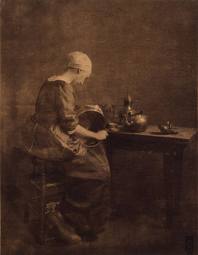
Myra used her housekeeper, Alma Schmidt, as a subject in several of her pictorial photographs of Dutch domestic life. Schmidt wore costumes and posed in a variety of theatrical scenes. No further record of their relationship exists.
No, more a holy meditation
on surface and stain
Madonna with Vessel.
The inland
glow of white shoulders
rivulet of vertebrae
vestige of one breath-
takingly long
and sexual arm
which grasps
the ledge
of the cauldron
as she curves onward.
*
Remember form:
nothing more
than potent omen ~
pyramid of saucepan top,
overflow
of water bucket, angle of the invisible
skin dimpled
underneath her arranged garment ~
a light-stroked body,
conflicted as rosewater, as clotted cream~
*
Alma, grace of more
than poor
Our Lady of the Scullery Shimmer ~
starlet of
returning questions
May I serve you?
*
Perhaps art as polish
gloss of what the photograph
pretends in voyeurism.
An aperture, a flash
of the nakedly conscious eye ~
a part of and apart ~
blessing identity until it blinds us.
*
Once, on a sunlit afternoon
a maidservant, an ingénue,
swept forward ~
into what this moment you
in Walla Walla, Soho, Barcelona ~
might admire, must revise ~
a woman’s hands: fingernails, blue.
Susan Rich is the author of three collections of poetry, The Alchemist’s Kitchen (2010) named a finalist for the Foreword Prize and the Washington State Book Award, Cures Include Travel (2006), and The Cartographer’s Tongue / Poems of the World (2000) winner of the PEN USA Award for Poetry. She has received awards The Times Literary Supplement of London, Peace Corps Writers and the Fulbright Foundation. Recent poems appear in the Harvard Review,New England Review, and The Women’s Review of Books.
“Polishing Brass” is an ekphrastic poem, based on a photo by Myra Albert Wiggins: